


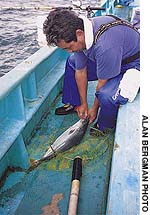
Autumn is my favorite time of year, and it’s also the season for one of my favorite saltwater game fish, the hard-fighting Japanese yellowtail (Seriola quinqueradiata). A member of the jack family, this is the best-known and most widely distributed of three very popular and closely related sport fish in Japanese waters, the other two being the kingfish or yellowtail (Seriola lalandi) and the greater amberjack (Seriola dumerili).
A highly valued food and game fish, the Japanese yellowtail can be found from Hokkaido to Taiwan. In Japan, this fish is known by a wide variety of names. In eastern Honshu around the Kanto region, fish in the 15-30 cm range are called wakashi, those of 40-50 cm are called inada, those from 60-70 cm are called warasa, and yellowtail weighing more than 7 1/2 kg are called buri. In the Kansai region, the same fish are referred to as tsubasu, hamachi, mejiro and buri respectively. To further complicate this name game, yellowtail that are raised commercially by aquaculture are sold throughout the country as hamachi.
Japanese yellowtail have dark-blue backs with an olive undertone, silvery-to-whitish sides and bellies, and, of course, yellow tails. They are easily distinguished from amberjack by their color and from kingfish by their shape. Japanese yellowtail have rounded, spindle-shaped bodies, while kingfish and amberjack have wider, flatter bodies.
With your current subscription plan you can comment on stories. However, before writing your first comment, please create a display name in the Profile section of your subscriber account page.