


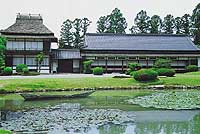
Next time you find yourself in Okayama Prefecture, down by the beautiful Seto Inland Sea in western Honshu, you could do worse than allow some time to visit Shuraku-en Park, a well-known historical garden in the Sanyo district of Tsuyama.
Constructed in 1657 at the order of Mori Nakatsugu, the second daimyo of Tsuyama-han (domain) in what is now the central part of the prefecture, in 1698 the garden came into the charge of Matsudaira Nobutomi, whose family held power in the domain until the Meji Restoration in 1868.
History records that Mori employed the skills of a gardener from Kyoto to design Shuraku-en, but that person’s name has been lost in the mists of time. Aligned on a north-south axis, however, what he (or she) created is clearly based on Sento-Gosho, one of Kyoto’s two imperial gardens. Here in Shuraku-en, as in Sento-Gosho, the central element of the garden is a pond, and all other features are carefully designed to harmonize with that. Both these gardens are kaiyu-shiki-teien (stroll gardens), a style that was popular among those of status during the Edo Period (1603-1867), when they were esteemed for their different landscapes, vistas and features created to please the eye and soothe the soul.
With your current subscription plan you can comment on stories. However, before writing your first comment, please create a display name in the Profile section of your subscriber account page.