


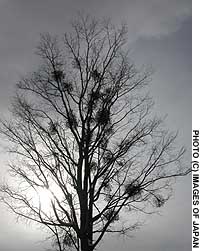
I am back in my local wood in Hokkaido yet again. From one spot, I can see the fluffed-out form of a Ural owl sunning itself at the entrance of its day roost, while looking in another direction and a little higher in the canopy of a towering elm, I find more than half a dozen spherical clumps, like strange squirrel dreys with a hint of dull green. Those clumps are Viscum album, otherwise known as mistletoe.
Owl and mistletoe is an odd pairing — were I more superstitious I might be torn between the deathly omen of the owl and the life-enhancing symbol of the mistletoe.
Japan’s mistletoes are evergreen parasitic plants that shun conifers and grow only on the branches of deciduous trees. The mistletoe’s fruit is a globular, smooth, white or red berry that ripens in December — a food source that thrushes, waxwings and bulbuls all find irresistible.
With your current subscription plan you can comment on stories. However, before writing your first comment, please create a display name in the Profile section of your subscriber account page.