


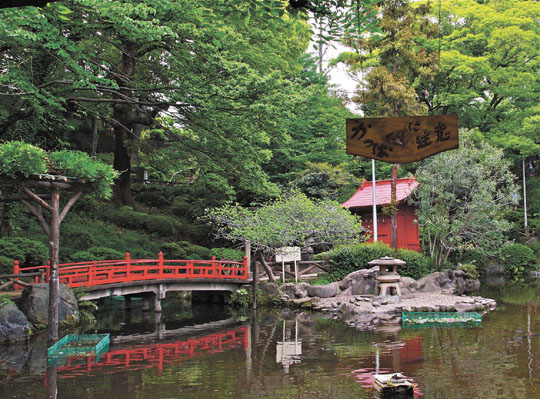
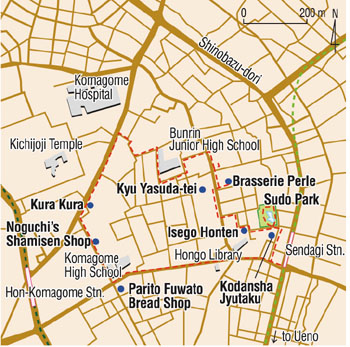
The Yanesen district of central Tokyo, whose name features bits of the names of the three neighborhoods it comprises (Yanaka, Nezu and Sendagi), charms visitors with its temple-studded streets, craft shops and prewar architecture. Oddly, though, maps in either Japanese or English rarely guide visitors west of the Chiyoda subway line’s Sendagi Station, which is where most of Sengagi is to be found. Intrigued, I set off to explore.
From Exit 1 of the station, I emerge at the bottom of Dangozaka (Dumpling Slope). Strange name, I think. Asking three passersby to explain it, I get three quite different answers. One says it’s from a hilltop dango shop; another cites dumpling-shaped pebbles that once dotted the path; while the last has it mocking the people and horses that used to tumble like dumplings down the steep incline.
Dangozaka’s certainly dumpling-to- dumpling with traffic, so I nip down a tiny backstreet between homes draped in the greenery of young summer. Right away I find a sculpted stone beside a copper plaque marking the spot where Seiji Noma (1878-1938) first collaborated with Dai Nippon Printing in 1909 to publish Yuben, a magazine circulating the oratory of members of the Tokyo Imperial University (forerunner of the University of Tokyo) debating club.
With your current subscription plan you can comment on stories. However, before writing your first comment, please create a display name in the Profile section of your subscriber account page.