


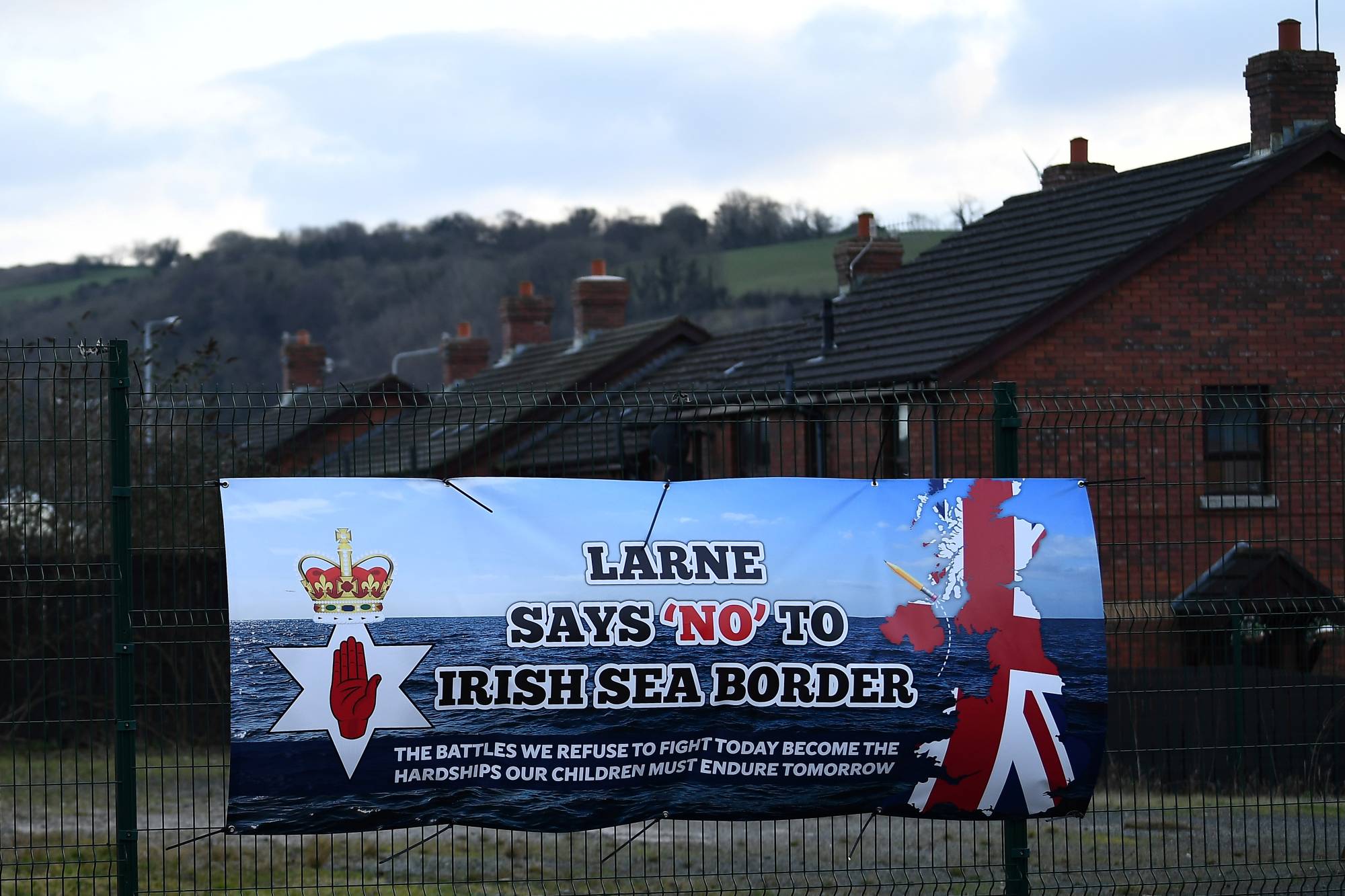
Today Northern Ireland, comprising most of the ancient province of Ulster, sits simultaneously inside the European Union Single Market (largely under EU trading rules and standards) and also within the United Kingdom, which has left the European Union and its single market.
How can that possibly be? The answer lies partly in the terms reached before the recent U.K. departure from the EU and partly deep in the Irish question, which has bedeviled British politics for generations, and indeed for centuries. The nature of the Irish question may change in form over time, but the issue in all its tortuous complexity is always there — and is now back once again with a vengeance. Partition of Ireland was the solution in the last century, but now it persists as the impossible problem in this one.
It might be thought that this was a specific and unique British (and Irish) headache and not of much interest to the wider world. But it is amazing how much interest the continuing dilemmas of the Irish situation generates internationally.
This is especially so in Japan. Maybe this is just the proverbial Japanese politeness inquiring about the current British condition similar to how one would ask about a friend’s health. But beyond polite inquiry, it is also an undoubted feature of today’s increasingly connected world. What may seem like difficult local issues within one state or neighborhood have a habit of causing frequent and instantaneous shock waves that reach all members in the global network, raising questions and implications far outside the originating zone.
The current Irish question is very much of this kind. It is a source of misunderstandings and bad feelings — disturbing U.K.-EU relations, as well as those on the other side of the Atlantic given the enormous legacy of immigration to the United States from Ireland, a country of which President Biden himself has strong ancestral ties. It challenges the future structure of the EU and its single market, obstructs future trade flows, threatens the unity (and potentially the peace) of the United Kingdom and raises questions about the future status of the Irish Republic itself.
KEYWORDS
In a time of both misinformation and too much information, quality journalism is more crucial than ever.
By subscribing, you can help us get the story right.
With your current subscription plan you can comment on stories. However, before writing your first comment, please create a display name in the Profile section of your subscriber account page.