


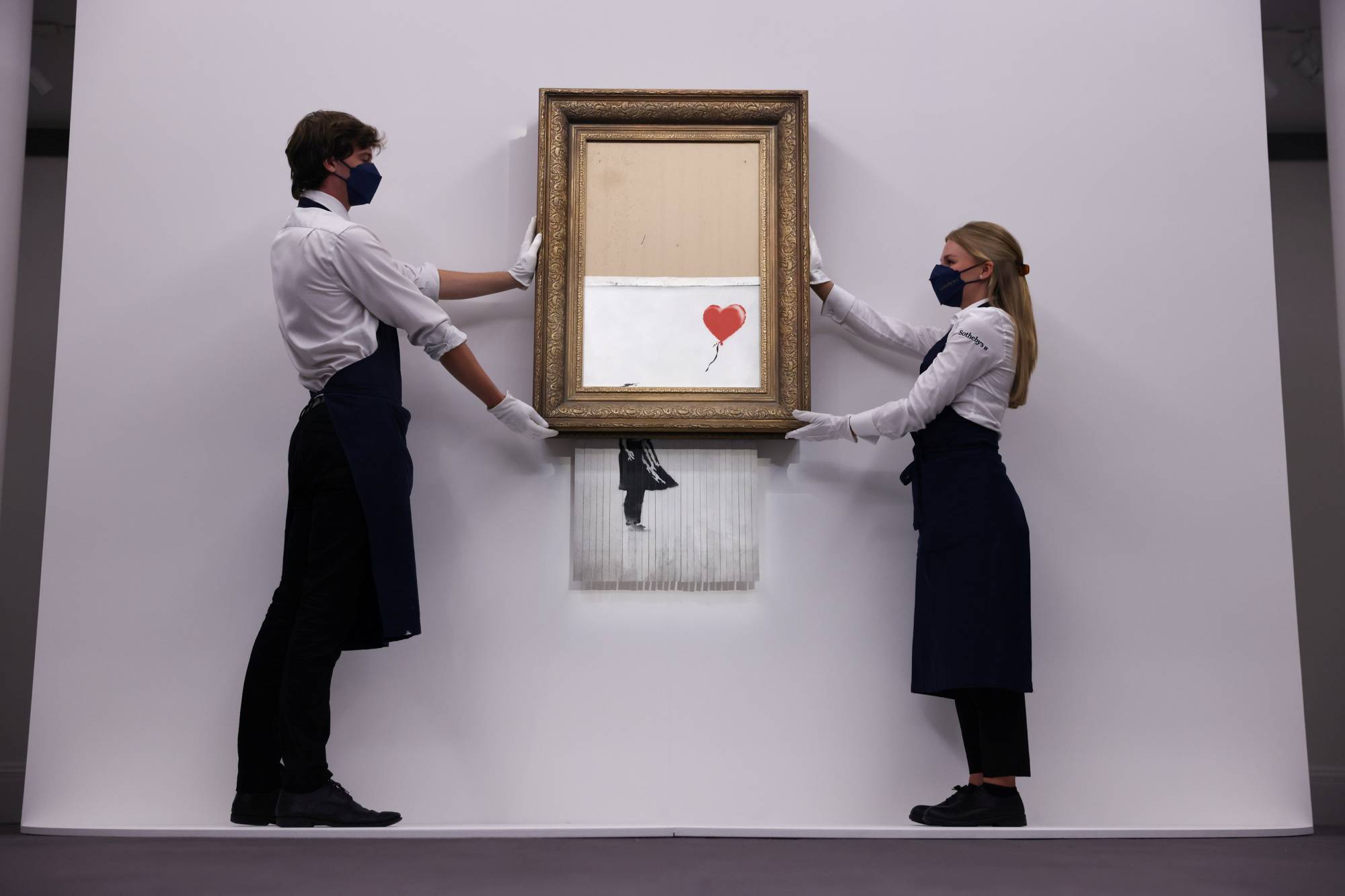
I’m a fan of contemporary art, especially abstract and performance art. And while I like the style and power of the British graffiti artist Banksy, I can’t decide if I am delighted or dumbfounded by the fate of one of his recent paintings.
Three years ago, when bidding ended for “Girl with Balloon,” one of his most iconic pieces, at Sotheby’s in London — selling for $1.4 million — a beeping commenced and the painting lowered itself into a shredder Banksy had secretly installed in the lower part of the frame, cutting the piece into strips. The act was branded social commentary of the highest order: “… an attention-grabbing spectacle (the shredding) taking place within an attention-grabbing spectacle (the auction), which highlighted through dark satire how art has become an investment commodity to be auctioned off to ultrawealthy trophy-hunters,” opined one critic for the BBC.
Last week, the buyer of “Girl with Balloon” got the last laugh. Retitled “Love is in the Bin” — described as “Decommissioned, remote controlled shredding mechanism remains in the frame” — the still half-shredded piece was again auctioned off, this time fetching $25.4 million, more than three times Sotheby’s highest estimate and more than 18 times what the 2018 purchaser paid.
It’s a fascinating commentary on what is art and the control that an artist has — or doesn’t have — over his or her work. Destruction isn’t unprecedented: In 1953, Robert Rauschenberg obtained a drawing from Willem de Kooning, erased, then framed and sold it. “Erased de Kooning,” a “drawing (with) traces of drawing media on paper with a label and gilded frame,” hangs today in the San Francisco Museum of Modern Art.
The proper value of art has been the focus of intense speculation amidst reports of the purchase of songwriting catalogues for some astronomical sums. Last December, Nobel laureate and folk singer Bob Dylan sold his songwriting catalog to Universal Music for more than $300 million. Stevie Nicks, the diva fronting Fleetwood Mac, sold a majority share of her catalogue for $80 million, while Neil Young sold half of his copyrights for an estimated $150 million and Paul Simon collected $250 million for the sale of his entire catalogue earlier this year.
In a time of both misinformation and too much information, quality journalism is more crucial than ever.
By subscribing, you can help us get the story right.
With your current subscription plan you can comment on stories. However, before writing your first comment, please create a display name in the Profile section of your subscriber account page.