


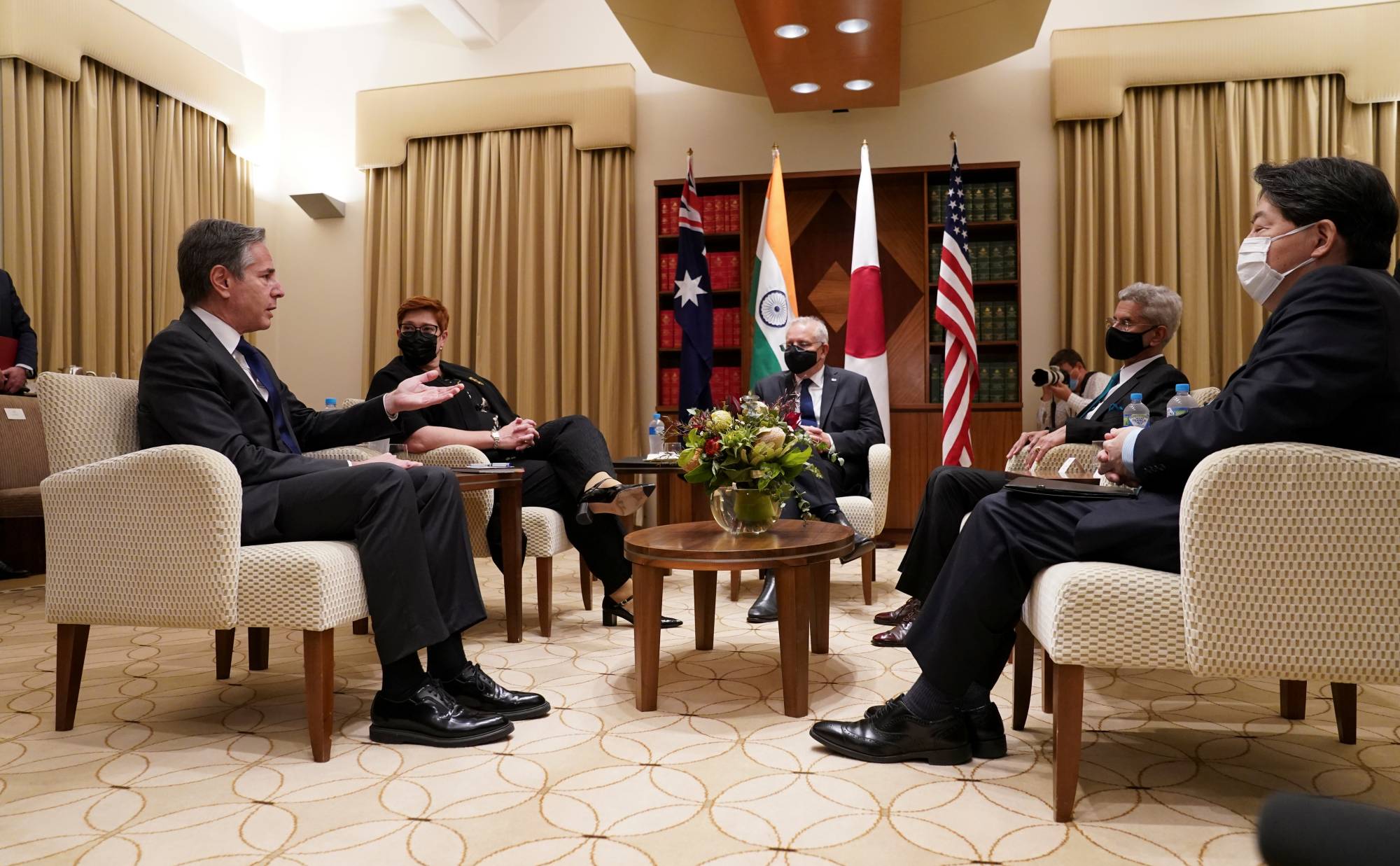
It is difficult to appreciate how much the Indo-Pacific security environment has changed.
The fact that we now commonly refer to the “Indo-Pacific” is a taste of the transformation. New threats have emerged, and new relationships forged and new mechanisms created to counter them. First, we had “the Quad,” AUKUS and the Indo-Pacific Economic Framework; this week we’re talking about the “Asia-Pacific Four” — Japan, South Korea, Australia and New Zealand — and Partners in the Blue Pacific, which includes the U.S., Japan, Australia, the U.K. and New Zealand. The changes have been gradual but they are paradigmatic, nevertheless.
As this evolution unfolds, a — if not “the” — central question is: What is the organizing principle for collective action to maintain the peace? What unites countries and allows them to cooperate? To ask this another way, for all the talk about “like-minded countries,” what is alike among them?
The most florid way to frame the discussion is as a morality play, a simple choice between good and evil (which side is which being obvious). In a speech last year, former U.S. Vice President Mike Pence charged that “China may not yet be an evil empire, but it’s working hard every day to become one.” That accusation focuses on Beijing’s repressive policies in Hong Kong and Xinjiang, its disregard for human rights within China itself and its disdain for the rule of law overseas. But the indictment includes other governments also deemed “evil.” (While this would seem to be an especially Western approach — the battle between good and evil reflecting its religious foundations — Chinese spokespersons have been unsparing in their depiction of the U.S. as “evil,” too.)
This is the emotionally loaded version of a less inflammatory framework for which the defining geopolitical threat is the clash of ideologies. In this analysis, freedom-loving democracy is the bulwark against authoritarianism, a tendency most manifest in the Marxist-Leninist dictatorship of the Chinese Communist Party. This structural distinction between democracies and dictatorships divides and aligns countries.
KEYWORDS
In a time of both misinformation and too much information, quality journalism is more crucial than ever.
By subscribing, you can help us get the story right.
With your current subscription plan you can comment on stories. However, before writing your first comment, please create a display name in the Profile section of your subscriber account page.