


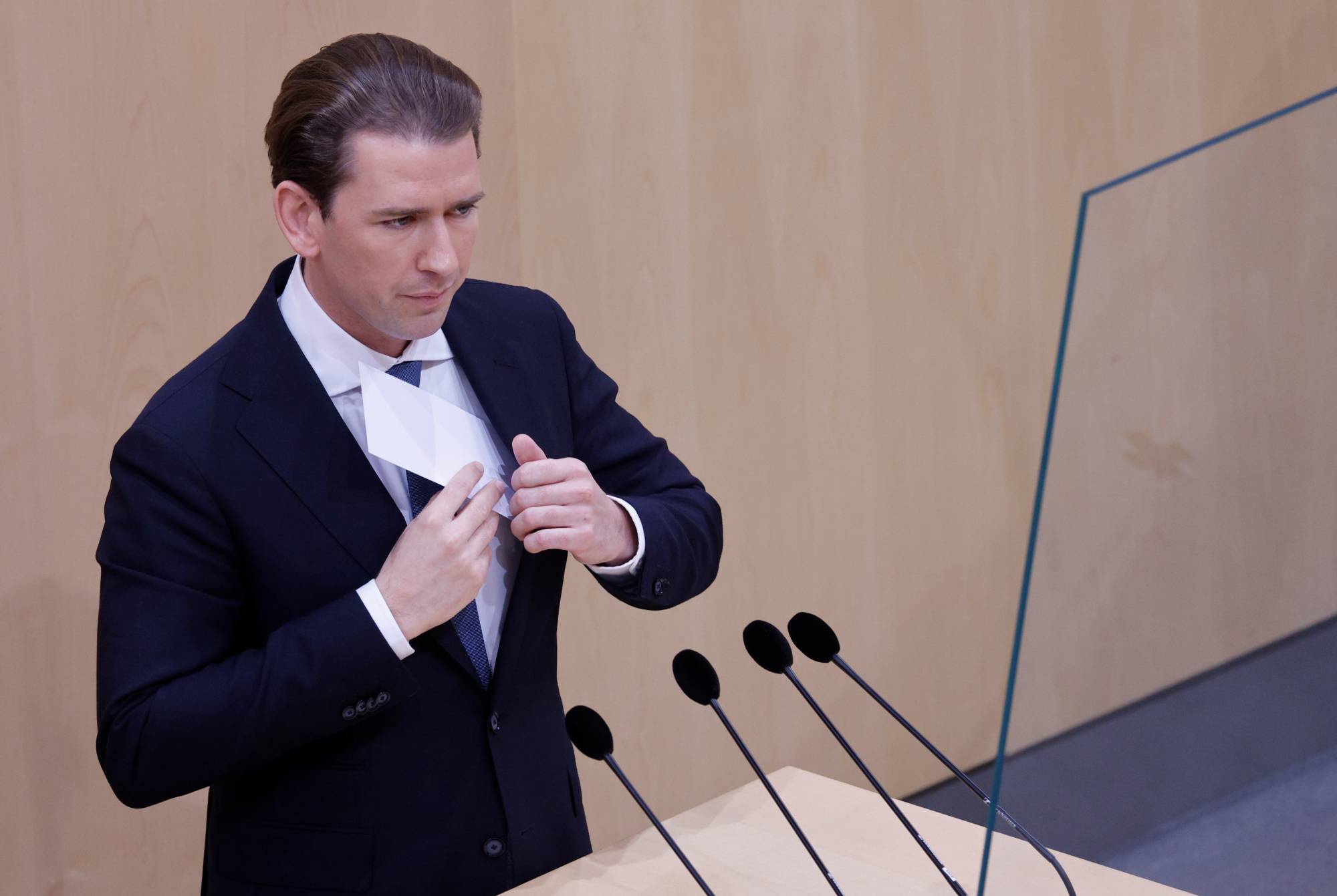
PRINCETON, New Jersey – The satirist Karl Kraus observed about his native Austria in 1899: “When the constitution is violated, the people just yawn.” How upset Austrians really were recently when Chancellor Sebastian Kurz was accused of corruption is unclear. But the charges — and the public leaks of vulgar chats involving Kurz and his colleagues — were serious enough to prompt his always somewhat unlikely coalition partner, the Greens, to bring him down
Kurz’s fall is widely seen as having consequences beyond Austria: his approach had been touted as a model for center-right parties across Europe, especially in Germany, where the Christian Democrats are currently in disarray after their dramatic election loss last month. But “Kurzism” has been all about style and tactics, not new political ideas or, for that matter, a sustainable alliance of social forces. Worse, Kurz’s model is downright dangerous for democracy.
Just 35 years old, Kurz has the distinction of having been ex-chancellor twice already. He was always the youngest and fastest: foreign minister at 27, chancellor at 31. He was also fast when it came to switching political positions: Initially liberal, he turned hard-liner on matters of immigration and refugee policy, in effect copying and mainstreaming the far-right Freedom Party (FPO). In 2017, he entered a coalition with the FPO. When a similar government had been formed in Austria in 2000, it set off alarm bells across Europe. This time, with Hungary and Poland having since pioneered the autocratization of EU member states, the creation of the Kurz coalition elicited only yawns.
Mainstreaming the far right has been a general trend across Europe, owing partly to the fact that center-right parties are bereft of ideas. For many years, the conventional wisdom has been that social democracy is in a terminal crisis. But the fact is that the proverbial man (or woman) on the street will be able to indicate roughly what it is about. The same has not been true of center-right forces: Christian Democrats, in particular, no longer push for European integration or offer a distinctive model, in line with Catholic social doctrine, for mediating conflicts between capital and labor.
Even after the fall of the Berlin Wall, they relied on a Cold War strategy of being the moderate center that served as a bulwark against communism. As Germany’s Christian Democratic Union (CDU) discovered a few weeks ago, because warnings about a red menace are so implausible, reliance on them is widely perceived as a sign of desperation and intellectual bankruptcy.
KEYWORDS
In a time of both misinformation and too much information, quality journalism is more crucial than ever.
By subscribing, you can help us get the story right.
With your current subscription plan you can comment on stories. However, before writing your first comment, please create a display name in the Profile section of your subscriber account page.